
"Bringing Community and Businesses together"
Listening…
Powered by ALICE — Your Palm Coast AI Guide
ALICE — Your Palm Coast AI Guide is Live!
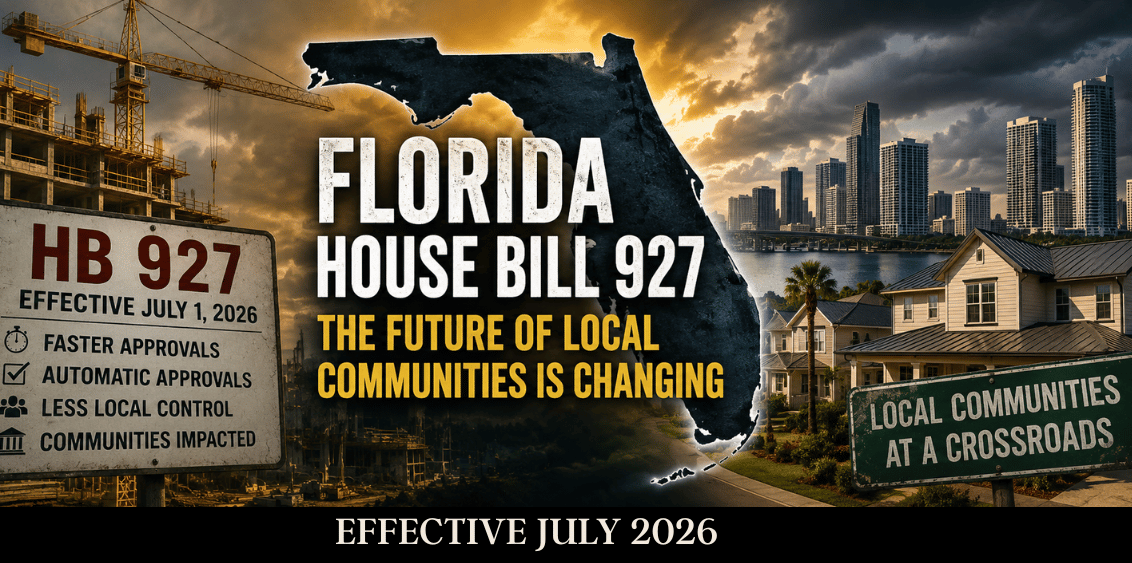
Florida’s newly signed House Bill 927 is one of those laws that may not sound dramatic at first glance — but it could significantly reshape how development happens across cities and counties throughout the state.
For many Florida residents, HB 927 is not just about development permits. It could influence how quickly neighborhoods expand, how local governments manage growth, and whether infrastructure such as roads, drainage, schools, and utilities can keep pace with Florida’s continuing population boom.
Signed into law by Ron DeSantis on May 6, 2026, most of the bill takes effect July 1, 2026. The legislation focuses on land planning, permitting, and development approvals, with the goal of speeding up housing and construction projects statewide.
Supporters say it cuts government delays and helps address Florida’s housing shortage.
Critics say it weakens local control and could accelerate growth faster than communities can handle.
For many Florida residents, this may become one of the most important growth-related laws they have never heard of.
HB 927 is a state law aimed at streamlining development approvals and reducing delays in local government permitting.
In simple terms, the law:
The law applies to many cities and counties across Florida and is expected to affect residential growth, subdivisions, infrastructure planning, and future development patterns.
Florida continues to experience rapid population growth, especially in suburban and coastal regions.
State lawmakers argue:
The state’s position is that Florida needs to build housing faster and reduce bottlenecks caused by local government review delays.
Supporters believe the law could:
One of the biggest changes involves private review contractors.
Under HB 927, many local governments must create registries of approved outside professionals such as:
Developers may hire these approved professionals to assist with reviews traditionally handled by local staff.
Supporters say this helps overloaded permit departments.
Critics worry it creates a system where developers can effectively pay for faster processing.
One of the most talked-about parts of HB 927 involves deadlines.
Local governments now face stricter timelines to:
If deadlines are missed after required notices are provided, certain applications may become automatically approved under state law.
For local communities, this changes leverage dramatically.
In the past, projects could sit in review for months.
Now, cities and counties may face pressure to act quickly or risk losing control over the outcome.
Many Florida communities are already struggling with:
Critics of HB 927 worry that faster approvals may outpace infrastructure planning.
This concern is especially strong in:
Some residents fear the law may accelerate development before roads, sewer systems, and emergency services are ready.
Most residents will likely never read HB 927 directly.
But they may notice its effects through:
Depending on where someone lives, this could be viewed positively or negatively.
Some Floridians support faster housing growth because of rising home prices and limited inventory.
Others worry Florida is growing faster than infrastructure can safely support.
Even if smaller municipalities are exempt from some provisions, growth pressure often spreads outward.
Communities once considered “too rural” or “too small” for major development are increasingly seeing:
HB 927 may accelerate those trends because approvals could move faster than before.
One of the broader debates surrounding HB 927 is something known as “home rule.”
Home rule refers to the ability of local governments to control decisions affecting their own communities.
Critics argue Florida has increasingly shifted authority away from cities and counties in recent years on issues involving:
Supporters say statewide consistency is necessary.
Opponents say local communities are losing the ability to shape their own future.
This debate is likely to continue long after HB 927 takes effect.
Most provisions begin July 1, 2026.
Many local governments will then begin:
Some cities and counties are expected to push back politically or legally, while others may embrace the faster approval process.
Either way, residents across Florida will likely begin hearing more discussions about:
because of this law.
No. Cities and counties still maintain zoning authority. However, the law reduces some flexibility in how long local governments can delay or review applications.
Not necessarily. Applications still must meet legal and technical requirements. However, missing deadlines can create situations where approvals happen automatically.
Possibly. Many experts expect the law to accelerate project timelines and encourage faster housing and subdivision growth.
Yes. Rural and agricultural areas could experience additional development pressure as Florida continues expanding inland.
Many worry infrastructure such as roads, schools, drainage, utilities, and emergency services may not keep up with accelerated growth.
Yes. One of the main goals of the law is increasing housing supply by reducing permit and approval delays.
Potentially. Faster development without matching infrastructure upgrades can place additional strain on roads, stormwater systems, and utilities.
Most provisions of HB 927 begin July 1, 2026.
Yes. Even smaller communities may feel indirect pressure as development expands outward from larger metropolitan regions.
Public hearings and participation processes still exist, but shorter review timelines may reduce how long projects remain under public discussion before decisions are made.
Sources:
Florida House Bill 927 Overview
Florida Senate Staff Analysis for HB 927
Add comment