Palm Coast Local
Locals Helping Locals

A New Florida Security Bill Uses Terms Like “Tradecraft” and “Patterns of Life.” What Do They Mean?
- Details
- Written by: Palm Coast Local
- Parent Category: Business Blog
- Category: Government
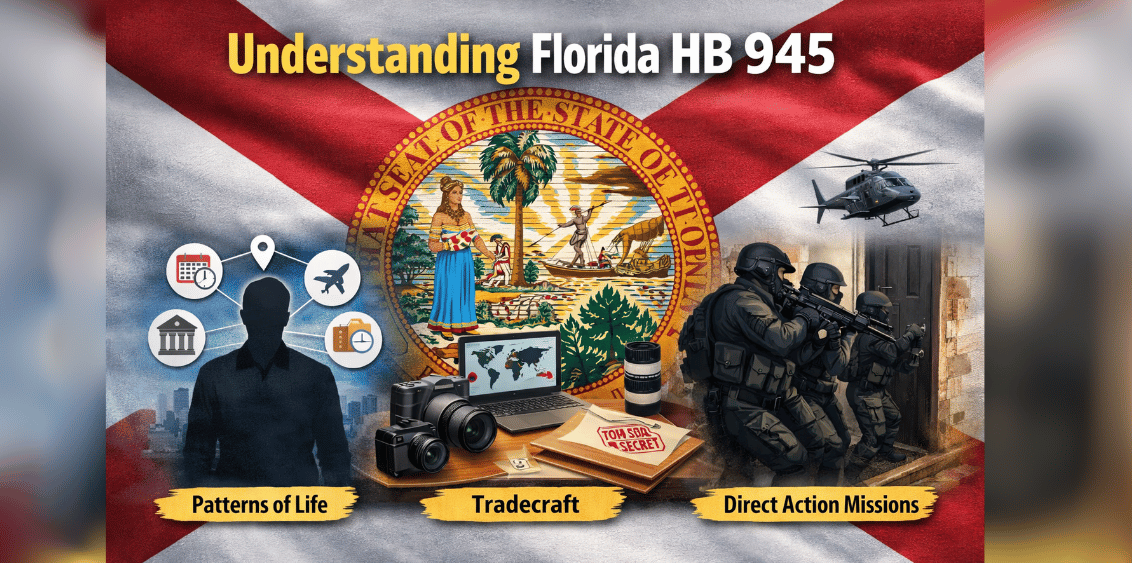
Understanding Florida HB 945
Breaking Down the Intelligence Language Inside the Proposed Law
As the Florida Legislature continues reviewing House Bill 945, some residents have begun looking more closely at the wording inside the proposal.
The bill would require the Florida Department of Law Enforcement (FDLE) to create a Statewide Counterintelligence and Counterterrorism Unit designed to identify and respond to potential threats to the state.
On the surface, the concept sounds straightforward. But when people begin reading the bill itself, they quickly encounter terminology that feels more like military or intelligence language than traditional law-enforcement statutes.
Terms such as “patterns of life,” “tradecraft,” and “direct action missions” appear directly in the legislative text.
For many readers, that raises an important question: what do these terms actually mean in practice?
To help clarify the discussion, we looked at several of the key phrases used in the bill and explained them in plain language so readers can better understand what the legislation is describing.
What HB 945 Proposes
House Bill 945 directs FDLE to establish and administer a Statewide Counterintelligence and Counterterrorism Unit.
According to the bill, the unit would be located at FDLE’s regional operational centers and aligned with Florida’s existing Regional Domestic Security Task Forces.
You can read the companion legislation, Senate Bill 1712, which proposes the formation of the same unit in the Florida Senate.
The unit’s responsibilities would include identifying potential threats, gathering intelligence related to terrorism or adversarial activity, coordinating with other law-enforcement agencies, and taking action to stop identifiable threats.
While those responsibilities are similar to other security programs, the bill introduces several phrases that are more commonly used in the intelligence community.
Understanding those terms can help readers better interpret what the legislation is describing.
Patterns of Life
One phrase that appears in the bill is “patterns of life.”
This term comes from intelligence and counterterrorism investigations and refers to analyzing a person’s daily routines and behavioral patterns over time.
Investigators may examine patterns such as travel habits, financial transactions, communication activity, online behavior, personal networks and associations, meeting locations, and physical movement.
The goal is to establish what behavior is normal for a person or group and then identify changes that may signal unusual activity.
In intelligence work, deviations from normal patterns sometimes provide early clues that an operation may be developing.
Actionable Intelligence
Another phrase used in the bill is “actionable intelligence.”
Not all information gathered during an investigation leads directly to enforcement. Actionable intelligence refers to information that can guide immediate action.
Examples might include intelligence that leads to arrests, disruption of a planned activity, identification of additional individuals involved in a network, or prevention of a potential attack.
In simple terms, it means information that allows investigators to move from observation to action.
Counterintelligence and Counterterrorism Tradecraft
The word “tradecraft” refers to the professional techniques used in intelligence and investigative work.
Examples of counterterrorism and counterintelligence tradecraft can include confidential informants, undercover investigations, surveillance operations, cyber investigations, digital forensic analysis, financial tracking, and intelligence sharing between agencies.
The term itself does not introduce a specific method, but rather refers to the collection of investigative techniques used by trained personnel.
Revealing Intent to Compel a Response
One unusual line in the bill states that investigators may reveal their intent in order to compel a response.
In intelligence operations, this typically means signaling to a suspect that they are being monitored or investigated.
The goal is to prompt a reaction that may reveal additional information, such as communication channels, other members of a network, changes in behavior, or operational plans.
Sometimes the reaction itself provides valuable investigative insight.
Direct Action Missions
The bill also uses the phrase “direct action missions.”
This terminology is more commonly associated with military or federal counterterrorism operations.
Within the context of the legislation, it suggests that the unit could take operational action when a threat is identified rather than only gathering intelligence.
Examples could include executing arrests, assisting other law-enforcement units, disrupting an operation before it occurs, or conducting enforcement actions related to identified threats.
This suggests the proposed unit would function as both an intelligence analysis team and an operational enforcement group.
The Definition That Determines Scope
Another important part of the bill defines what qualifies as an adversary intelligence entity.
Definitions in legislation matter because they determine who investigators can legally target or investigate.
In general terms, the bill describes adversary intelligence entities as individuals, groups, or organizations involved in activities that threaten the interests of the state or the United States.
That could include foreign intelligence operations, espionage networks, terrorist organizations, or coordinated efforts targeting critical infrastructure.
Some observers have noted that the definition is broad, which is why it has drawn attention during legislative discussions.
Why the Language Feels Unfamiliar
Most state law-enforcement statutes use familiar terminology such as investigations, criminal activity, warrants, and arrests.
HB 945 includes language more commonly found in national security and intelligence operations.
Terms like patterns of life, tradecraft, and direct action are frequently used by agencies involved in counterterrorism and intelligence work.
Seeing those terms appear in a state statute is one reason the bill has drawn additional public interest.
What Happens Next
Like all legislation in Florida, HB 945 must still move through the full legislative process, including committee reviews, votes in both the House and Senate, and final approval from the governor.
If passed, the law would require FDLE to establish the unit and begin building the operational structure described in the bill.
Frequently Asked Questions
Does this mean my phone conversations or emails could be monitored?
Not automatically. Like other law-enforcement investigations, monitoring private communications such as phone calls, text messages, or emails generally requires legal authorization, typically in the form of a court-approved warrant. The bill describes intelligence gathering related to potential threats, but any monitoring of private communications would still need to follow existing federal and state privacy laws.
Does “patterns of life” mean the government would track everyday people?
The phrase refers to a method investigators use to understand behavioral patterns connected to specific investigations or identified threats. It typically involves examining activities connected to individuals or groups already under investigation, such as travel patterns, financial transactions, or communication networks.
Could this unit operate independently from local law enforcement?
The bill states that the proposed unit would be aligned with Florida’s Regional Domestic Security Task Forces, which already involve cooperation between local, state, and federal agencies. In practice, that means the unit would likely work alongside existing law-enforcement agencies, sharing information and coordinating responses rather than operating entirely on its own.
Community Discussion
Do you believe Florida should establish its own state-level counterintelligence unit?
Should intelligence-style investigative methods be used at the state level, or reserved primarily for federal agencies?
How should oversight and transparency work for programs designed to address security threats?
Add comment